
More pressure. More possibilities.
High-pressure gas boosters
Haskel gas boosters for cylinder filling, pressure testing and supplying production processes.
GAS BOOSTERS
Main applications
- Cylinder filling
- Pressure testing
- Production processes
- Make use of the gas source
- Boost pressure even as supply pressure drops.
- Select the booster
- Select by gas type, required pressure and flow.
- Integrate into the system
- A standalone booster or an application-specific system.
Oxygen or hydrogen service requires specific selection of model, materials and cleanliness level.
Product family technical information ←
Your brochures
Download promotional brochure (PDF) ↓Download technical brochure (PDF) ↓Brochure content is also available to read on this page. The original PDF files have not undergone screen-reader tagging verification.
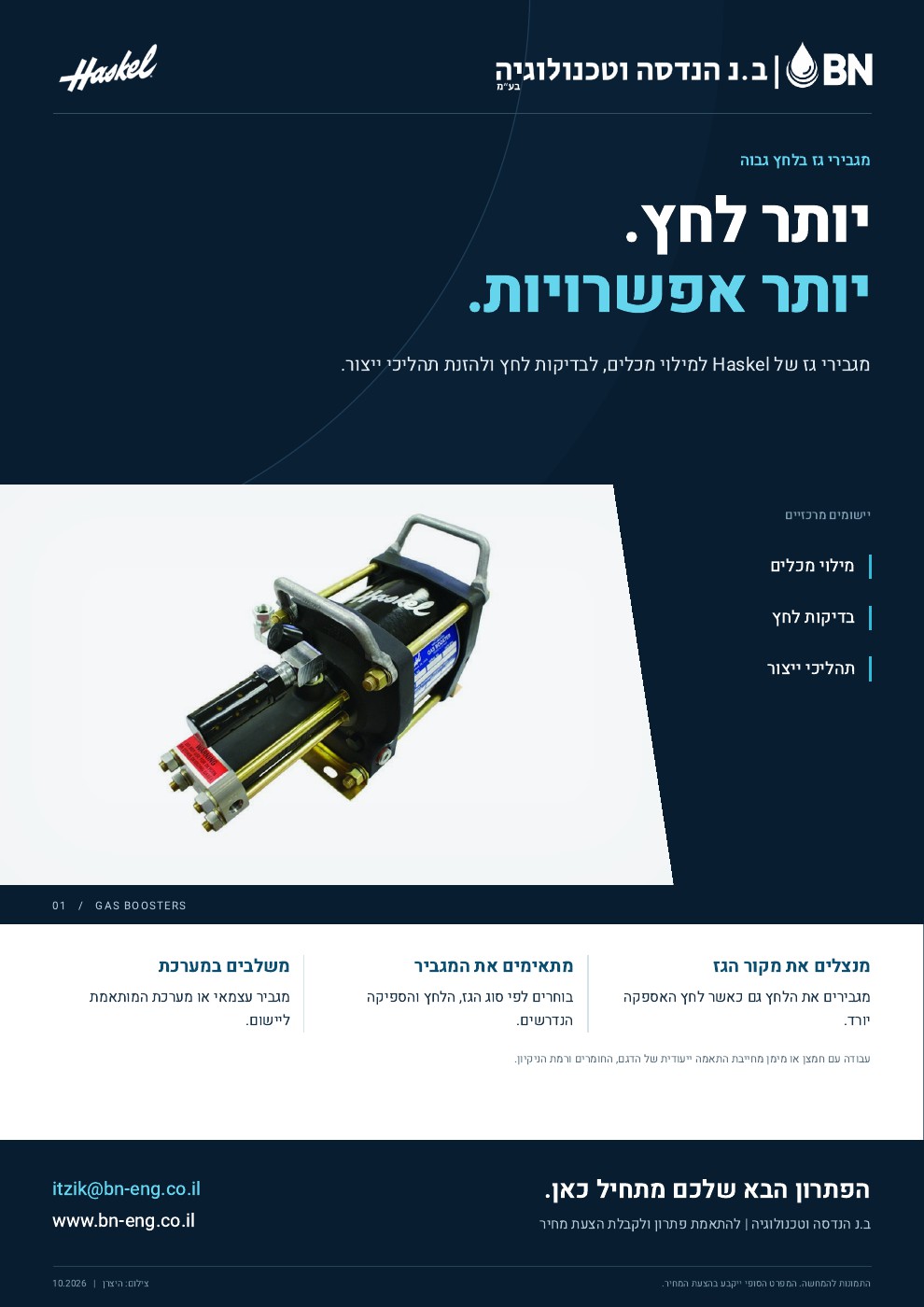
Original artwork in Hebrew; the publication text is available on this page.
Choosing a gas booster.
Configuration, drive conditions and gas compatibility
- Maximum family pressure, depending on model
- 2,690 bar
- Three boosting configurations
- AG / AGD / AGT
- Compressed-air drive
- PNEUMATIC
Booster families
| Series | Design | Selection feature |
|---|---|---|
| AG | Single-acting, single-stage | Single-stage solution for various gas applications |
| AGD | Double-acting, single-stage | Twice the displacement per cycle of a corresponding single-acting model |
| AGT | Two stages | Two-stage boosting when a high pressure ratio is required |
Flow varies with inlet pressure, outlet pressure and air supply. Select using the model's performance curve.
Operating conditions and system requirements
- Drive-air temperature
- -4°C to +65°C With standard seals
- Air quality
- Manufacturer recommendation: at least class Class 4 according to ISO 8573.1
- Air and electricity
- No air-line lubricator required; the pneumatic drive requires no electrical connection
- Separation and cooling
- Three dynamic seals and two vent chambers separate gas from drive; most models use exhaust-air cooling
- Oxygen and hydrogen
- Dedicated model, seals, materials and ventilation are required. In the gas catalogue: up to 345 bar for oxygen service in the appropriate configuration
What is needed for selection?
Gas type • Initial and minimum supply pressures • Outlet pressure • Flow, or cylinder volume and filling time • Available air pressure and flow.
The maximum pressure value applies to the family, not every model or gas. Final selection is determined by the operating point.
Brochure source: Gas Booster Booklet · pages 2-5. Data is taken from existing materials; suitability is checked against the model and current manufacturer document.